17th February, 2026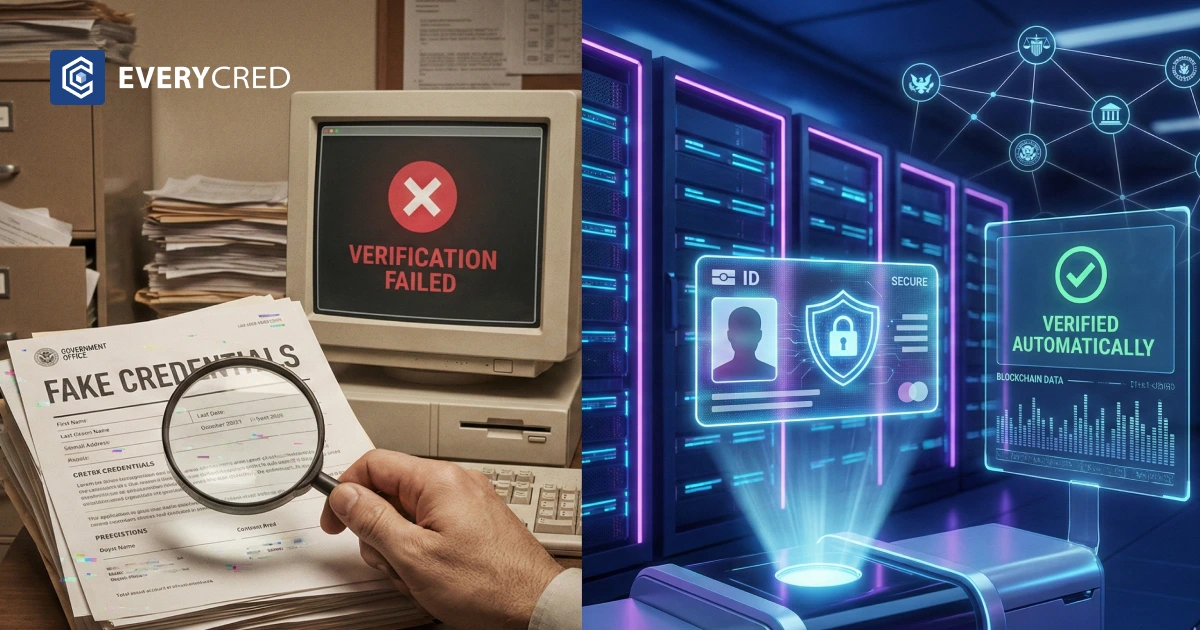


Government agencies in the USA face a significant increase in sophisticated identity theft. Traditional manual verification methods have become insufficient to stop high-level fraud. Human reviewers cannot consistently detect the advanced fake credentials produced by generative artificial intelligence. For compliance heads, the transition to government verification automation is no longer a matter of convenience but a requirement for operational security.
The core problem lies in the technical gap between modern fraud tools and legacy review processes. When a human agent reviews a scanned document, they look for visual inconsistencies. However, current synthetic media tools create documents that are visually perfect. These documents pass “sight” tests because they use high-resolution templates and correct biometric data harvested from various data breaches.
The Inherent Weakness of Manual Review
Manual verification relies on subjective human judgment. This subjectivity creates two primary risks for government agencies: high error rates and slow processing times. Fraudsters exploit these weaknesses by submitting large volumes of applications simultaneously. This tactic, known as “velocity attacks,” overwhelms manual reviewers and leads to oversight.
The complexity of fake credentials has reached a point where they include embedded security features that appear authentic under standard light or basic digital inspection. According to the National Institute of Standards and Technology (NIST), modern digital identity standards now require a move toward cryptographically protected data to counter these threats. Manual processes cannot verify the digital provenance or the “chain of trust” of a document. They only verify what the document looks like, which is an unreliable metric in the current era.
The table below outlines the specific differences between manual and automated verification in the 2026 fraud environment.
| Feature | Manual Verification | Government Verification Automation |
| Detection of AI-Generated ID | Extremely low; depends on human sight. | High; uses forensic and cryptographic checks. |
| Processing Speed | Minutes to hours per document. | Milliseconds per verification. |
| Scalability | Limited by staff count and working hours. | Unlimited; scales with cloud infrastructure. |
| Verification Basis | Visual inspection of physical or digital images. | Cryptographic signatures and verifiable credentials. |
| Human Error Margin | 10-20% under high-volume pressure. | Less than 0.1% consistent error rate. |
The Role of Government Verification Automation
To maintain compliance and protect public funds, agencies are adopting government verification automation. These systems do not just look at the pixels on a screen. They analyze the metadata of the file and attempt to verify the digital signature of the issuing authority. Automated systems can cross-reference submitted data with authoritative government databases in real-time.
Automation allows for the implementation of “Continuous Workforce Assurance.” Instead of checking an identity once during onboarding, automated systems can periodically re-verify credentials against revocation lists. This is critical for preventing fraud that occurs after the initial account creation. Agencies can learn more about these processes by reviewing how EveryCRED services integrate with existing government workflows.
Address the Threat of Fake Credentials
The term fake credentials in 2026 refers to more than just a forged physical card. It includes synthetic identities where a fraudster combines real Social Security numbers with fake names and addresses. These identities are used to open accounts and claim benefits. Manual reviewers often fail to see the patterns of synthetic identity because they only see one application at a time.
Automated systems identify these patterns by analyzing large datasets across multiple agencies. They detect if the same biometric signature is linked to different sets of personal information. This level of analysis is impossible for a human team to perform manually. The failure to detect these fake credentials leads to billions of dollars in losses annually.
Move Toward Verifiable Credentials
The most effective defense against modern fraud is the adoption of verifiable credentials. Unlike a PDF or a scanned image of a license, verifiablecredentials are digital data packages signed with a private key by the issuer. When a citizen presents a verifiable credential to a government agency, the agency uses the issuer’s public key to confirm the data is authentic and has not been tampered with.
This technology removes the need for human judgment in the verification process. The system either validates the cryptographic signature or it does not. There is no middle ground for a human reviewer to interpret. This standard is supported by the World Wide Web Consortium (W3C) as the global benchmark for digital trust. By using verifiable credentials, agencies ensure that the information they receive is directly from the source.
Strategic Implementation for Compliance Heads
Compliance heads must focus on replacing legacy systems with interoperable digital frameworks. This involves three specific actions:
- Updating procurement requirements to prioritize “Machine-Verifiable” data over “Human-Readable” images.
- Integrating decentralized identifiers (DIDs) to allow for secure, peer-to-peer data exchange without centralized databases that can be breached.
- Training staff to manage the automated systems rather than performing the verifications themselves.
The transition to verifiable credentials significantly reduces the administrative burden on government staff. It also improves the citizen experience by providing instant approvals for legitimate applicants. Agencies interested in the technical details of these credentials can find extensive information in the EveryCRED guide to verifiable credentials.
The Cost of Inaction
Continuing to rely on manual checks is a liability. Fraudsters use automation to find the weakest point in government defenses. If an agency uses manual review, it is the weakest point. The cost of fraudulent payouts far exceeds the investment required for government verification automation. Furthermore, the legal landscape in 2026 is shifting. Compliance officers may face professional negligence claims if they fail to implement industry-standard fraud prevention tools that are readily available.
The persistence of fake credentials in government systems erodes public trust. When legitimate citizens see their identities stolen and used for fraudulent claims, they lose confidence in the agency’s ability to protect their data. Rebuilding this trust requires a transparent and technically sound verification process.
Lead the Change with EveryCRED
EveryCRED provides the infrastructure necessary for agencies to move beyond manual verification. The platform supports the issuance and verification of verifiable credentials using blockchain-powered technology. This ensures that every credential is tamper-proof and instantly verifiable.
EveryCRED’s solution for the public sector is designed to meet the strict security requirements of USA government agencies. The system automates the verification of professional licenses, identity documents, and academic records. By implementing EveryCRED, agencies eliminate the risks associated with manual review and effectively block the submission of fake credentials.
The platform provides a secure digital wallet for citizens, allowing them to store and share their credentials with full control over their data. This aligns with modern privacy regulations and reduces the amount of sensitive information that agencies must store on their own servers. EveryCRED’s government verification automation tools integrate seamlessly via API, allowing for rapid deployment without disrupting existing services.
Conclusion
Manual verification is an obsolete method in the face of 2026 fraud levels. The rise of AI-generated fake credentials has made visual inspection unreliable. Government agencies must adopt government verification automation to ensure the integrity of their programs. By transitioning to verifiable credentials, compliance heads can implement a security model based on mathematical certainty rather than human intuition. This shift protects public funds, reduces operational costs, and secures the digital identity of every citizen.