18th February, 2026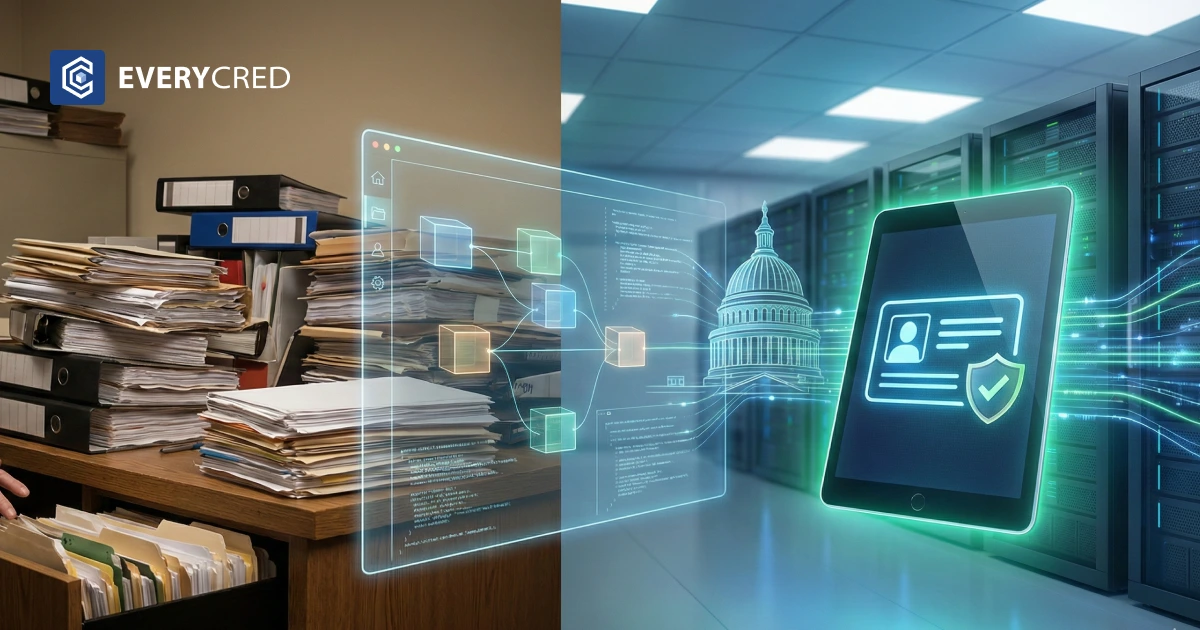
- The Failure of Manual Compliance Logs
- Establish Cryptographic Proof with Verifiable Credentials
- Automate the Audit Trail
- Meet Federal Identity Standards
- Interoperability Between Agencies
- Cost Reduction and Resource Allocation
- Prevent Credential Fraud with Digital Verifiable Credentials
- Achieve Continuous Compliance with EveryCRED
- Conclusion


Government compliance officers face increasing pressure to maintain accurate records. Regulatory bodies demand stricter oversight, while budgets for manual administration shrink.
The traditional approach to compliance relies on paper trails, spreadsheets, and reactive data gathering. This method often fails during an audit. It leaves agencies vulnerable to errors, data gaps, and fraud.
Agencies must shift from reactive data collection to proactive, automated verification. The solution lies in audit ready digital credentials.
These tools transform how government entities issue, manage, and verify licenses, certifications, and clearances.
By adopting a digital-first approach, agencies ensure that their records remain compliant by default, not just during an inspection.
The Failure of Manual Compliance Logs
Most government agencies still rely on manual verification processes. Staff members physically check documents, make phone calls to issuing bodies, and manually enter data into centralized databases. This process creates significant lag time between issuance and verification.
Manual logs are susceptible to human error. A misspelled name or an incorrect date can invalidate a record. During an audit, these small errors compound into significant compliance failures. Furthermore, physical documents do not provide a real-time status of a credential. A license revoked yesterday might still appear valid on a paper certificate today.
Digital credentials solve this latency problem. They replace static physical documents with dynamic data files. These files update in real-time. When an issuing authority revokes a license, the digital credential reflects that change immediately. This capability is essential for maintaining a high-integrity audit trail.
Read more about the risks of manual verification in our guide on Professional License Verification: Automated vs. Manual
Establish Cryptographic Proof with Verifiable Credentials
To satisfy government auditors, a record must be authentic and tamper-evident. Standard PDFs or image files do not meet this standard. Anyone with basic editing software can alter a digital image.
Agencies must use verifiable credentials. A verifiable credential is a specific type of digital credential that uses cryptography to prove its origin. When an agency issues a verifiable credential, it signs the data with a unique cryptographic key.
This signature effectively “seals” the data. If a holder attempts to change a single character in the credential, such as an expiration date or a qualification level, the cryptographic seal breaks. The verification software immediately flags the credential as invalid.
The World Wide Web Consortium (W3C) defines the global standards for this technology. Their Verifiable Credentials Data Model ensures that these digital records work across different systems and borders. Adherence to W3C standards guarantees that a credential issued by one department remains technically valid when presented to another, regardless of the software they use.
Automate the Audit Trail
An audit assesses the “who, what, and when” of a transaction. Auditors need to know who issued a credential, who received it, and when it became active. In a manual system, compliance officers reconstruct this history from scattered emails and logs.
Audit ready digital credentials build this history automatically. Every action taken on the credential records to a secure ledger or log. This includes issuance, sharing, verification, and revocation.
When an auditor requests proof of compliance, the agency generates a report instantly. The report shows the exact cryptographic chain of trust for every individual. There is no need to manually reconcile spreadsheets. The data exists in a verified state at all times.
This automation reduces the administrative burden on government staff. Compliance teams spend less time gathering papers and more time on strategic oversight.
Learn how we secure data with our Digital Trust Services.
Meet Federal Identity Standards
Federal agencies in the United States must adhere to strict identity guidelines. The National Institute of Standards and Technology (NIST) provides the framework for secure identity management. Their guidelines, specifically NIST SP 800-63, emphasize the need for phishing-resistant authentication and secure credential storage.
Verifiable credentials align with these federal requirements. They allow agencies to verify the identity of the holder with a high degree of assurance. Unlike a username and password, which can be stolen, a verifiable credential resides in a user’s secure digital wallet. The user must authorize its presentation.
This structure protects privacy. A holder can prove they possess a valid security clearance without revealing unnecessary personal details. This feature, known as selective disclosure, is critical for government agencies handling sensitive personnel data.
By implementing digital credentials that meet NIST standards, agencies protect themselves against identity fraud. They ensure that only authorized individuals access government facilities or systems.
Explore how our platform handles Digital Identity Verification.
Interoperability Between Agencies
Government work often involves cross-agency collaboration. A contractor might need clearance from the Department of Defense to work on a project for the Department of Energy. In the past, this required redundant background checks and re-issuance of badges.
Verifiable credentials enable interoperability. Because they follow open standards, different agencies can read and verify each other’s credentials. The Department of Energy can instantly verify a clearance issued by the Department of Defense without manual phone calls.
This interoperability speeds up onboarding. It reduces the “time-to-credential” for new hires and contractors. It also eliminates the friction of moving personnel between departments. The credential travels with the user, and the receiving agency validates it instantly against the issuer’s public key.
Cost Reduction and Resource Allocation
Maintaining audit ready digital credentials lowers operational costs. Physical credentialing requires printers, plastic cards, shipping, and secure storage. It also requires staff hours to manage these physical assets.
Digital issuance eliminates these material costs. The marginal cost of issuing a digital credential is near zero. Agencies reallocate the budget saved on materials to other critical security functions.
Furthermore, the cost of a failed audit is high. Fines, legal fees, and reputational damage plague agencies that fail to prove compliance. Automated verifiable credentials act as an insurance policy against these penalties. They provide 100% data accuracy, mitigating the risk of non-compliance fines.
Compare credentialing platforms in our analysis of EveryCRED vs. Competitors.
Prevent Credential Fraud with Digital Verifiable Credentials
Fraud detection is a primary duty of compliance officers. Sophisticated forgeries of paper certificates are difficult to detect with the naked eye. Bad actors use high-quality printers to replicate watermarks and seals.
Digital credentials make forgery mathematically impossible. The cryptographic signature is unique to the issuer. A bad actor cannot forge this signature without the issuer’s private key.
If an employee leaves the agency or loses their clearance, the agency revokes the credential. The revocation status propagates to the blockchain or distributed ledger immediately. Any attempt to use that credential subsequently fails. The verifier sees a “Revoked” status instantly. This capability prevents the “ghost employee” problem, where former staff retain access to secure areas using old badges.
Achieve Continuous Compliance with EveryCRED
Government agencies require a platform that simplifies the transition to audit ready digital credentials. EveryCRED provides the infrastructure to issue, manage, and verify credentials at scale.
The EveryCRED platform integrates directly with existing government HR and LMS systems via API. It allows agencies to issue W3C-compliant verifiable credentials without replacing their current software stack.
EveryCRED’s capabilities for government compliance include:
- Tamper-Evident Issuance: All credentials utilize cryptographic signing to ensure data integrity.
- Real-Time Verification: Auditors and other agencies verify status instantly via QR code or API.
- Hosted White-Label Solutions: Agencies maintain their branding and trust authority while utilizing EveryCRED’s secure backend.
- Data Sovereignty: Data storage options meet strict jurisdiction and residency requirements for public sector data.
Agencies using EveryCRED establish a permanent, immutable audit trail. They eliminate the scramble to gather data before an inspection. Instead, they operate in a state of continuous readiness.
Conclusion
The shift to audit ready digital credentials is not optional for modern government agencies. It is a necessary evolution to meet the demands of security, efficiency, and regulatory compliance. By replacing paper trails with verifiable credentials, compliance officers ensure accuracy and reduce fraud.
They create a system where trust is automated, and verification is instantaneous. This transition protects the agency from audit failure and builds a more secure foundation for public service.
Contact EveryCRED today to assess your agency’s audit readiness.